Contextual Background
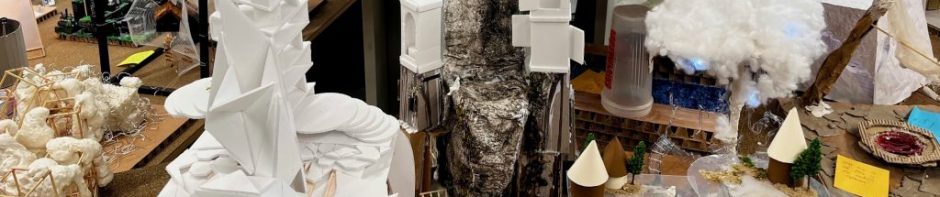
I temporarily reduced my technician contract to teach a five-week unit as an Associate Lecturer for first-year BA Interior and Spatial Design students. Students are divided into groups of 15, each assigned to a tutor. The unit is based on Invisible Cities (Calvino, 1972), and tasks students with interpreting a fictional city through a 30x30cm conceptual model. Challenges included the short timeframe, variable attendance, and translating literary descriptions into spatial forms.
Evaluation
To support students in navigating the abstract brief, I provided a printed worksheet structured in two parts. The first focused on analysing the text, highlighting architectural, material, and thematic cues. The second shifted toward making, prompting students to consider materials, sketch iterations, and anticipate challenges. This helped students overcome creative blockages and begin making early. I also asked them to produce 2–5 iterations of a part of their model for the following week. This proved effective: students referred to the form often and appreciated the structure.
Moving Forwards
The printed form I introduced was well received by students, and several kept referring to it in the first couple of weeks. It helped them break the initial hesitation and provided a structure they could either follow or adapt. This also proved helpful for me: when students haven’t started producing material yet, it can be difficult to engage in meaningful discussion and feedback. The worksheet created a shared ground from which we could discuss ideas with greater clarity. Structuring the early stages of a unit in this way aligns with findings that students benefit from clear scaffolding, especially when dealing with open-ended or conceptual briefs (Moon, 2004; Biggs and Tang, 2011).
This approach mirrors strategies I already use in my technical teaching. When delivering Rhino 3D sessions, I often prepare partially completed files that students can begin to engage with straight away. I’ve found these sessions smoother and more focused, especially for those new to the software. Although it adds to my preparation time, it reduces stress for both me and the students. The more I plan the start of a session with clarity and intention, the more effective the learning seems to be.
Our PGCert microteach was particularly helpful in that regard. Seeing how colleagues began their sessions—some through clear contextualisation, others through more playful, open-ended provocations—helped me reflect on my own assumptions about what “effective” teaching looks like. I realised I tend to over-structure, which may not suit every learner. I’m learning to adapt, and to recognise that multiple entry points can coexist within a session (Brookfield, 2017).
Another technique I’ve used is showing students an example of a finished output at the beginning of a task. For instance, when introducing Rhino, I bring a small 3D-printed object based on the exact model we will be working on. It gives students a tangible goal and helps them stay engaged throughout the session.
I’m starting to see more clearly that how a session or a unit starts has a significant impact on how students engage with it, especially in short units or fast-paced contexts. A well-thought-out beginning, whether it’s a visual reference or a guided worksheet, can help reduce anxiety and spark curiosity across a range of teaching settings.
References
Biggs, J. and Tang, C. (2011) Teaching for Quality Learning at University. 4th edn. Maidenhead: Open University Press.
Brookfield, S. (2017) Becoming a Critically Reflective Teacher. 2nd edn. San Francisco: Jossey-Bass.
Calvino, I. (1972) Invisible Cities. Translated by W. Weaver. London: Vintage Books.
Moon, J. (2004) A Handbook of Reflective and Experiential Learning: Theory and Practice. London: RoutledgeFalmer.